Newsletter · claude
Ten skills worth writing.
The ten Claude skills I wrote for the people I teach: what each one does, why it works, and a request to try:

People ask me the same question every week.
"I get what a skill is. But what should I actually make one for?"
So here's my answer, in full.
These are the ten skills I wrote for the people I teach.
Each one does one job, the way I'd want it done.
I'll show you what each does, the rules that make it work, and a request to try.
Steal the ideas. Then write your own versions, for the way you work.
What's inside:
- Two skills for learning
- Two for research
- Two for your career
- Two for everyday work
- One for data
- One that writes the others
- How to choose your first
Get the next one in your inbox
One practical guide at a time: the exact steps, the prompts to copy and the mistakes to skip.
Free. Delivered by Substack, one click to unsubscribe. Form not showing? Subscribe on Substack.
The ten, on one page
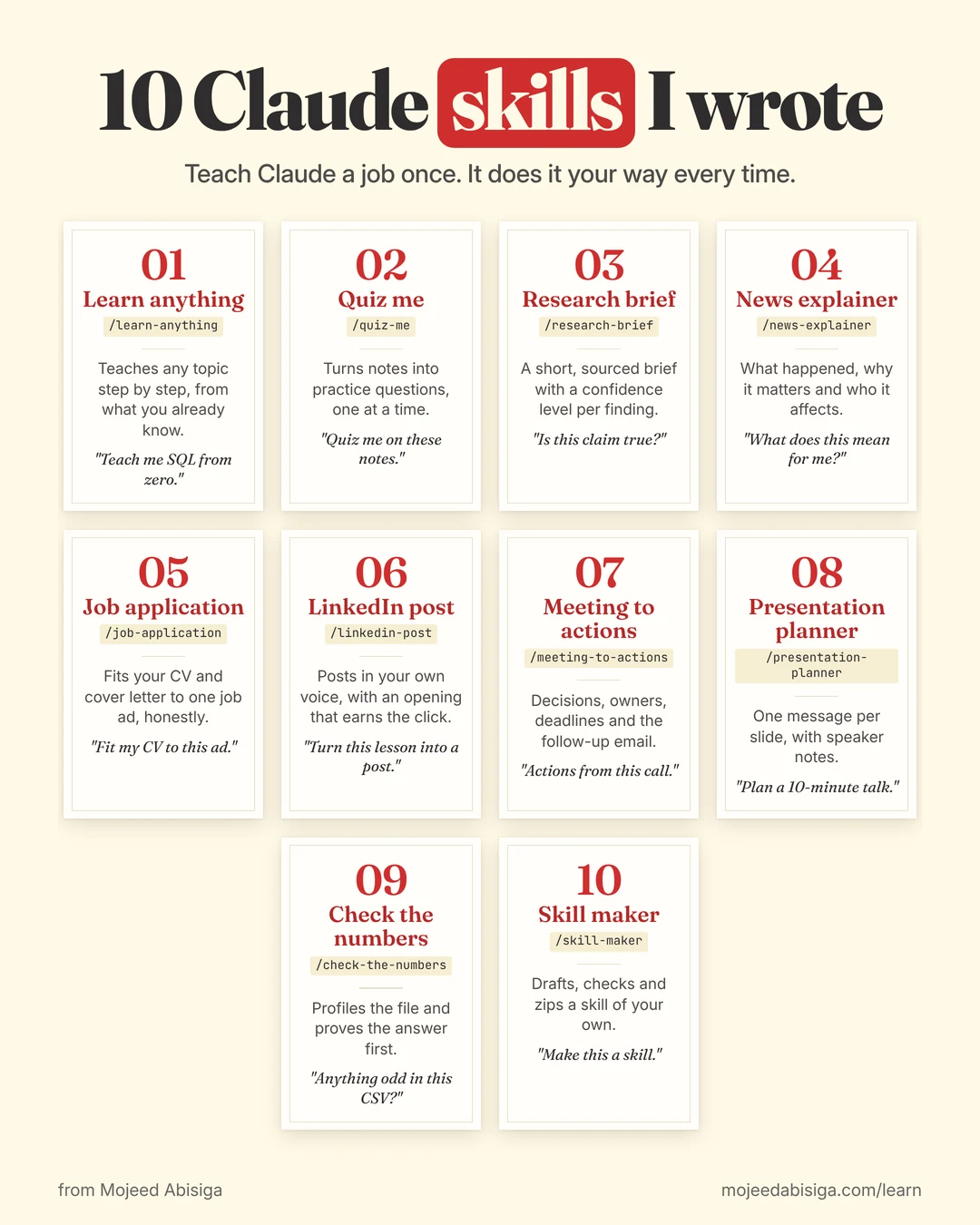
Every skill below follows the same pattern.
A clear job. A few firm rules. One thing it never does.
That last part matters most. A good skill isn't only what Claude does. It's what Claude refuses to do.
Learn and remember
learn-anything
A patient tutor for any topic.
It doesn't start explaining right away. First it asks what you already know.
Then it makes a short plan, and explains one idea at a time, each with an analogy and a small example. Before moving on, it checks you understood.
Why it works: most explanations start in the wrong place. Too basic, and you're bored. Too advanced, and you're lost. Asking first fixes both.
Teach me how neural networks learn. I know basic algebra.quiz-me
Turns your notes, a document or a topic into practice questions.
It asks them one at a time. It explains every answer, keeps track of what you miss, and comes back to it.
Why it works: reading notes feels like learning. Answering questions is learning. And coming back to the ones you missed is where it sticks.
Quiz me on these lecture notes. Ten questions, mixed.Make your own version: the five steps
Research and explain
research-brief
Answers a question with a one-page, sourced brief.
It separates what's known from what's only claimed. It gives each finding a confidence level. And it never invents a source.
Why it works: the danger with AI research isn't a wrong answer. It's a wrong answer that sounds certain. Confidence levels and real sources make the uncertainty visible.
news-explainer
Turns AI and tech news into a plain explainer, in four parts:
- What happened
- Why it matters
- Who it affects
- What's still unknown
Every claim is attributed. No hype.
Why it works: the fourth part. Most news coverage skips what isn't known yet. Naming it keeps you honest with your readers.
Explain this announcement for my newsletter readers.Paste the link or the text under it.
Grow your career
linkedin-post
Writes LinkedIn posts in your own voice, from an idea, a lesson or a piece of work.
You get an opening worth reading and one clear point.
What you don't get: invented stories or engagement bait.
Why it works: it learns your voice from your own old posts. So the post sounds like you on a good day, not like a template.
Turn this project I finished into a post. Here are two of my old posts.job-application
Tailors your CV and cover letter to one specific job ad.
It matches your real experience to what the employer asks for. And it tells you honestly where the gaps are.
Why it works: honesty. A tailored CV that invents experience falls apart in the interview. One that tells you where you're weak gives you time to prepare.
Here's my CV and the job ad. Tailor both.Get the next issue by email
One practical guide at a time: the exact steps, the prompts to copy and the mistakes to skip.
Free. Delivered by Substack, one click to unsubscribe. Form not showing? Subscribe on Substack.
Get work done
meeting-to-actions
Turns meeting notes or a transcript into:
- the decisions
- the actions, with owners and deadlines
- the open questions
- a follow-up email, ready to send
It never invents an owner or a date.
Why it works: a summary nobody acts on is wasted. Owners and deadlines turn a meeting into work that gets done. And refusing to invent them means you find the gaps before they cost you.
Here's the transcript of today's team call.presentation-planner
Plans a talk before you open slide software:
- the story
- one message per slide
- titles that state the point
- the visuals
- the speaker notes
Why it works: most bad decks are a planning problem, not a design problem. Fix the story first, and the slides almost write themselves.
Plan a ten-minute talk on our quarterly results for the board.Work with data
check-the-numbers
Answers questions about spreadsheets, CSV files and SQL results, and proves the answer first.
A script profiles each file before Claude answers:
- missing values
- numbers stored as text
- repeated rows and keys
- gaps in the dates
Every join is checked for multiplied rows. And the answer comes with its caveats.
Why it works: this is the skill where a script earns its place. Checking data must come out the same every time, and code does that better than words.
Which products drove last quarter's revenue? Here's the export.Make your own
skill-maker
The one that writes the others.
It interviews you about a task you repeat. Then it writes the SKILL.md, checks it against the rules, and packages the folder as a zip, ready to upload.
Why it works: the hardest part of a skill is describing your own job. Being interviewed is much easier than starting from a blank page.
Help me turn the way I write our weekly report into a skill.The full walkthrough: make your first skill
What a good skill looks like inside
Every skill above is the same shape inside: a name, a description, and short, firm instructions.
Here's how learn-anything could look, so you can see the pattern:
---
name: learn-anything
description: Teaches any topic step by step, starting from what the learner already knows. Use when someone asks to learn, understand or be taught a topic.
---

## Steps
1. Ask what I already know about the topic, and why I want to learn it.
2. Make a short plan: three to five ideas, in order.
3. Explain one idea at a time, with an analogy and a small example.
4. Ask one question to check I understood before moving on.

## Mistakes to avoid
- Don't explain everything in one long answer.
- Don't move on if my answer shows I'm confused.

## Example
(one short exchange you liked)
Notice three things.
The description says what and when. That's how Claude knows to reach for it.
The steps are numbered and short. Claude follows them in order.
The mistakes come from real failures. Every line there is something that went wrong before the skill existed.
Make them yours
These ten are starting points, not finished products.
The best skills capture the tasks you repeat every week, the way your organisation does them.
So before you write your version, ask:
For learning skills
What do you study most? A new tool, a field, a language? Put your level and your goal into the instructions.
For research skills
Which sources do you trust? Which ones should never be cited? Write that down.
For career skills
Paste two of your best posts, or the CV you're proudest of, as the example. That's what teaches Claude your voice.
For work skills
What does your team's format look like? Headings, order, length, tone. The more exact, the better.
For data skills
What goes wrong with your data most often? Missing dates, duplicate rows, text where numbers should be? Make the skill check for exactly that.
How to choose your first
Don't write ten.
Look at your last week of chats with Claude. Find the job you explained more than once.
That's your first skill.
Then ask three questions before you start:
- Is it one job, not three?
- Have I explained it to Claude three times already?
- Can I describe when Claude should use it, in one line?
Three ticks? Start writing.
NewsletterCheck a skill before you trust it.A Claude skill can run code on your behalf. Here's what can go wrong, and the five-minute check to run first:What to do today
Pick one of the ten.
Try its request in a normal chat, without a skill.
Notice what you had to explain, and what Claude got wrong.
That list is the first draft of your skill.
NewsletterMake your first skill.Turn the instructions you paste into Claude every day into a skill that does the job your way:If this helped, send it to one person who uses Claude every day.
Mojeed